The Checkout Line Test: What 'Making It' Looks Like When You Still Count Every Dollar
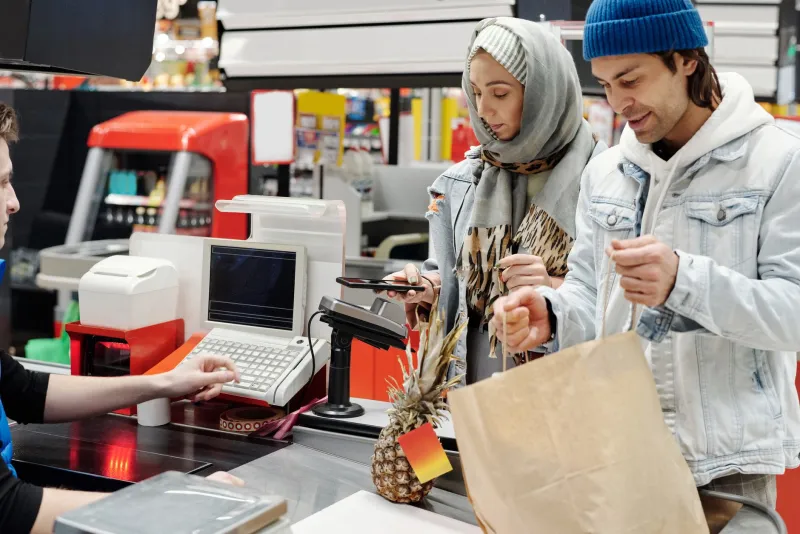
There's a moment nobody warns you about when you stop qualifying for SNAP benefits. It's not the letter from the state. It's not even the first paycheck that tips you over the income line. It's standing in the checkout lane at a Winn-Dixie in Jacksonville, or a Hy-Vee in Des Moines, or a Kroger in Louisville, realizing that the way you shop — the way you've had to shop — doesn't turn off like a switch.
Maria Delgado laughs about it now, pushing a cart through the same Aldi she's shopped at for six years. Her cart looks the same as it did when she was on benefits: dried beans, whole chickens, a mountain of bananas because they were 89 cents a pound. The difference is invisible. Her income crossed the threshold eight months ago. Her food culture didn't budge.
"People think once you make a little more money, you celebrate with steak," she says. "We celebrated by not being afraid of the electric bill. The groceries stayed the same."
The $47 Arithmetic
Ask around among families who've recently transitioned off benefits and a number keeps coming up: somewhere in the forties, sometimes fifties — the weekly grocery budget that stuck around long after the EBT card went into a drawer.
Maria, a medical billing assistant and mother of two in Florida, runs her household on roughly $47 a week. So does Devon Carter, a warehouse worker in Columbus, Ohio, who aged off benefits last spring when his hours increased. And so does the Ruiz family in Fresno, California, who lost eligibility when grandma moved in and her Social Security income counted toward the household total.
None of them set a number on purpose. The number set itself, forged during years of stretching benefits across the last week of the month, when the pantry got creative and the meals got humble.
"You learn what a dollar does," Devon says. "A dollar in beans feeds you twice. A dollar in the frozen food aisle feeds you once and you're hungry again by ten."
What Survives the Transition
Here's what surprised each of them: the habits built under scarcity turned out to be the most valuable thing they carried across the line.
Devon's Sunday routine hasn't changed in three years. Two whole chickens, spatchcocked on a sheet pan, roasted at 425 until the skin crackles. Meat picked off for the week, bones into a stockpot with the sad ends of carrots and celery. By Monday night the house smells like a restaurant, and by Wednesday that stock becomes tortilla soup, thickened with crushed leftover chips his kids think is a delicacy.
Maria keeps a running price list in her phone — not out of paranoia, but because knowing that rice is cheaper at Aldi while produce is cheaper at the weekly flea market lets her shop like a strategist instead of a survivor. "There's a difference," she insists. "Surviving is grabbing whatever's cheapest. Strategizing is knowing the rotation."
The Ruiz family cooks from their grandmothers' playbook: sopa de fideo, huevos con papá, rice and beans that stretch across days without ever tasting like leftovers. "Our income went up," Isabel Ruiz says, "but our grandmothers already solved this problem decades ago. We just kept their answers."
The Recipes That Carried Them
Ask any of these families for their anchor dishes and you'll hear variations on a theme: cheap proteins treated with respect, starches that multi-task, and vegetables used as flavor first, volume second.
Devon's sheet pan chicken is the backbone of his week — two birds, seasoned with smoked paprika and garlic powder from the dollar store, roasted over a bed of quartered potatoes that cook in the drippings. Total cost: about $11. Feeds his family of four for three dinners.
Maria's beans start Friday night, a pound of pintos sorted and soaked while she watches TV, simmered Saturday with a ham hock that costs $2.29. Half get eaten as beans and rice. Half get blended into refried beans that become breakfast with eggs, lunch with tortillas, and a base for Saturday's soup.
The Ruiz family's sopa de fideo — toasted vermicelli in a blended tomato broth — costs maybe $3 for a pot that feeds six. Isabel's mother-in-law taught her to toast the noodles in oil first, until they're golden and nutty. "That step," Isabel says, "is the difference between poor-people soup and soup people ask for."
That phrase comes up again and again in these conversations: the refusal to let a tight budget mean joyless food. These aren't deprivation kitchens. They're kitchens where technique does the heavy lifting that money can't.
The Mindset Nobody Talks About
There's a psychological residue to food scarcity that a higher paycheck doesn't wash away. Devon admits he still feels a jolt of anxiety when the fridge gets below half-full, even though he could afford to fill it. Maria buys rice in bulk "just in case," keeping a deep pantry that her budget technically no longer requires.
Researchers who study food insecurity call this the "scarcity mindset," and it's often framed as a problem to be fixed. But the families I spoke with pushed back on that framing. Their caution, they say, is why they're still off benefits two years running. The buffer exists because they built it.
"My counselor told me I should learn to relax about food," Devon says. "I told her relaxing is how people end up back where I started. I'll relax when my kids are grown and fed."
Isabel puts it more gently: "We didn't get good with money. We got good with food. The money followed."
What 'Making It' Actually Means
If you're looking for a triumphant ending — a steak dinner, a Whole Foods haul, a fridge full of organic everything — these families will disappoint you. Their version of making it is quieter: a savings account with four months of groceries in it. A kid who knows how to cook rice without measuring. The absence of that specific dread at the end of the month.
Maria sums it up in the checkout lane, loading her identical cart into her slightly-less-old car. "People ask when I'm going to eat 'normal' now that I can afford it. I tell them this is normal. This is how you're supposed to eat. We were eating right the whole time — we just couldn't afford for anyone to know."
The $47 haul isn't a constraint anymore. Somewhere along the way, it became a philosophy: waste nothing, plan everything, and let the beans do what beans have always done — carry a family through.