Seven Strangers, One Folding Table: The Year a Minnesota Cul-De-Sac Learned to Eat Together
The first dinner was, by every account, a disaster.
Dana Whitfield stood in her garage in Maple Grove, Minnesota, watching six people she'd only waved at from driveways hover near the door, holding grocery-store veggie trays like shields. Someone had brought a slow cooker full of meatballs. Nobody knew anyone's last name. The folding table wobbled every time someone reached for a drink.
"Honestly, I almost called it off," Dana laughs now, fourteen months later. "I stood there thinking, we have nothing in common. This is going to be the longest hour of my life."
That was eleven dinners ago. Today, the group — now nine households — has a group chat, a rotating schedule, and strong opinions about whose peach cobbler wins. Two members have keys to each other's houses. When one neighbor's father died in the spring, three families showed up at the funeral with food before anyone had to ask.
The Awkward Phase Is the Point
Dana didn't set out to build community. She set out to stop feeling invisible. After twelve years as an ICU nurse, she'd come home from night shifts to a quiet house, a quiet street, and a quiet kind of dread. "We lived forty feet from other humans and I couldn't have told you their names," she says. "That felt insane once I actually said it out loud."
So she taped a flyer to nine mailboxes: Monthly potluck. My garage. Bring anything. No pressure.
That "no pressure" part matters more than she knew. The early meetings were stilted — weather talk, small talk, the particular agony of chewing in silence with strangers. But food does something conversation alone can't. It gives everyone a job. It fills the gaps. You can always compliment a casserole when you can't think of a question.
By month three, the veggie trays had disappeared. People started actually cooking. Rick from two doors down, a retired machinist who'd barely spoken since moving in, brought his late wife's jambalaya and told the story behind it. "That was the night it stopped being a dinner and started being a thing," Dana says.
What the Research Has Been Saying All Along
The loneliness Dana describes isn't a personal failing — it's the water we're swimming in. The Surgeon General issued an advisory on loneliness in 2023, comparing its health impact to smoking fifteen cigarettes a day. Meanwhile, the American Time Use Survey shows that the share of Americans eating dinner alone keeps climbing, year after year.
The antidote, researchers keep finding, is almost embarrassingly simple: shared meals. Studies on family and communal dining link regular meals with others to lower rates of depression, better cardiovascular markers, and stronger feelings of belonging. The University of Oxford's Robin Dunbar has found that people who eat socially more often report higher life satisfaction — and that the effect holds even when you control for income and exercise.
None of this surprises the Maple Grove crew. "I cook more now than I have in twenty years," says Rick. "Because somebody's actually going to eat it. That's the whole thing. Cooking for one is a chore. Cooking for nine is a reason."
How to Start Your Own (Yes, Even If It's Awkward)
A year in, Dana has become an accidental consultant for neighbors in other towns starting their own versions. Her rules are simple:
Keep it small and hyper-local. Don't invite the whole subdivision. Pick five to ten households within walking distance. Proximity is what turns a dinner party into a habit.
Make it a rotation. Different host each month spreads the labor and gets everyone inside each other's homes — which matters more than you'd think.
No theme, no rules, no hosting anxiety. Paper plates are fine. Store-bought is fine. The meatball era of the Maple Grove club is remembered with genuine fondness.
Commit to a year. The awkward first few months are not a sign of failure. They're the toll you pay at the bridge. "If we'd quit after month two, we'd still be strangers," Dana says.
The Second Dinner That Changed Everything
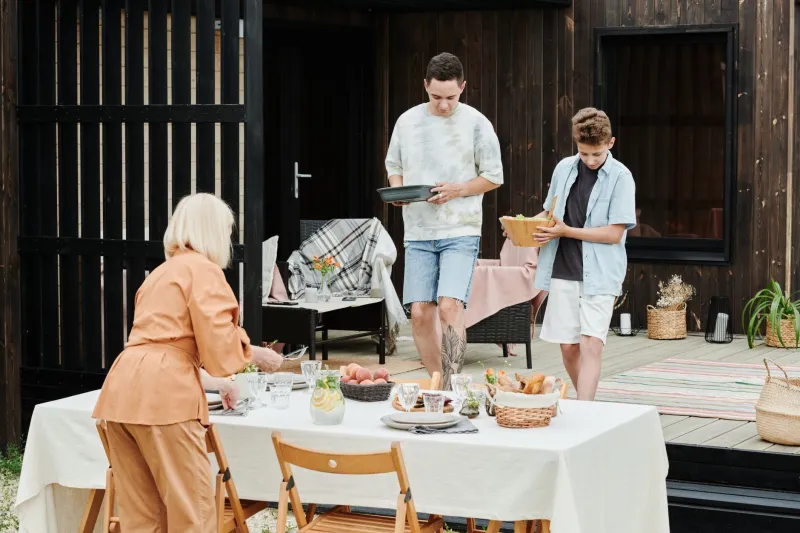
This past November, the club did something new: a Friendsgiving potluck the Saturday before Thanksgiving, held indoors for the first time because — well, Minnesota. Nine families, a long table made of two folding tables pushed together, a turkey Rick smoked for seven hours and would not stop talking about.
Halfway through dinner, Dana's husband looked around and said, "You know most of America isn't eating like this tonight."
It's true. Most of us are eating in the car, or over the sink, or alone in front of a screen. The fix isn't a program or an app. It's a folding table, a slow cooker, and the willingness to sit through one awkward hour with your neighbors.
"The food was never really the point," Dana says. "But the food was always the way in."
That's the quiet transformation happening in garages, church basements, and backyards across the country — one casserole, one meatball, one nervous first dinner at a time.