Two Dinners, One Marriage: When Only Half the Household Changes How It Eats
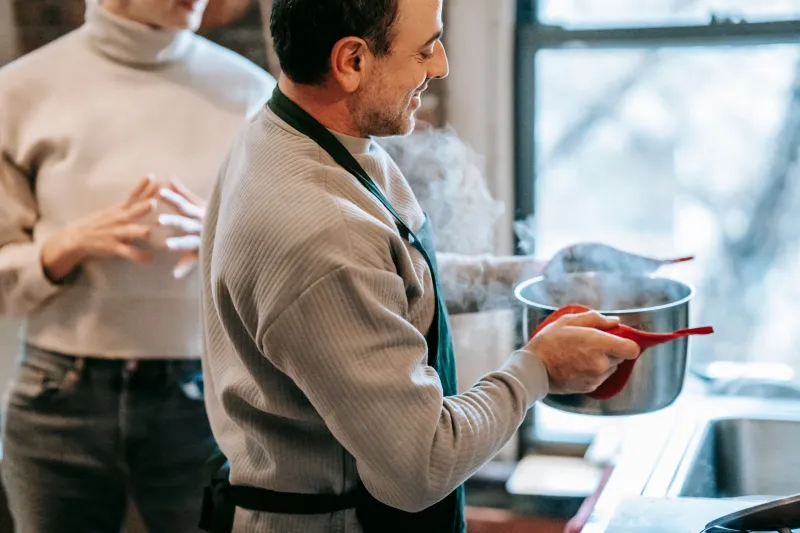
The cast iron skillet sat in the same spot it had occupied for nineteen years. But lately, in the Michigan kitchen Dana and Rick shared, it had started to feel less like a shared tool and more like a disputed asset.
Dana had lost 60 pounds after a prediabetes diagnosis, rebuilt her plate around vegetables and lean protein, and started cooking like a person with a mission. Rick still wanted his brats, his tater tot casserole, his Sunday pancakes the way his father made them. And so, without ever sitting down to discuss it, they arrived at an arrangement a lot of American couples will recognize: two dinners, one table.
"People assume the hard part is the diet," Dana told me over the phone, laughing a little. "The hard part is the refrigerator."
The Kitchen Nobody Agreed to Share
Couples therapists have a term for the way households divide invisible labor, but cooking occupies a stranger category than dishes or laundry. It's identity work. Who shops, who seasons, who decides what Sunday means — those choices encode decades of family history, and they rarely get renegotiated until something forces the issue.
A health transformation is exactly that kind of force.
When one partner changes how they eat, the other partner is handed a decision they never asked to make: come along, stay put, or carve out a separate territory. And the answer shapes everything from the grocery budget to, in more cases than you'd guess, the floor plan. Ask around and you'll hear about second freezers in the garage, shelf systems quietly divided down the middle, pantries that now have a "his" side.
The second freezer is the tell. It shows up again and again in these stories — the spouse who buys a chest freezer so the old way of eating has somewhere to live, literally outside the house. It's not always a hostile act. Sometimes it's a peace treaty.
Rick and the Garage Freezer
Rick bought his freezer three weeks after Dana's diagnosis. "I felt guilty, honestly," he says. "Like I was sneaking around. But I also thought, she doesn't need a dozen frozen pizzas staring at her every time she opens the door."
So the pizzas moved to the garage, along with the frozen lasagnas and the family-size bags of corn dogs. Rick walks out there when he wants something from the old life, brings it in, cooks it on the same stove, and eats it at the same table where Dana has her grilled salmon and roasted broccoli.
It sounds bleak described that way. In practice, they both say the arrangement saved them. Dana doesn't have to negotiate with temptation every night. Rick doesn't feel policed. And somewhere in the middle, without anyone announcing it, they started eating one shared meal a week — usually Saturday, usually something Dana cooks that Rick grudgingly admits is "actually good."
"The freezer's not forever," Rick says. "I go out there less than I used to."
The Role Reversal Nobody Saw Coming
Marcus, a 52-year-old high school coach in Georgia, came to cooking late — after his wife Priya's bariatric surgery made him, almost overnight, the household's primary cook. "I married a woman who could make anything," he says. "Then her stomach was the size of an egg, and suddenly I'm on YouTube at 10 p.m. learning what to do with a spaghetti squash."
His learning curve was steep and, by his own account, humbling. Portion sizes that had fed them both for thirty years no longer made sense. Leftovers worked differently. A pot of gumbo became three weeks of his life instead of three days.
But the deeper shift was what it did to his sense of himself. "I didn't realize how much of my man-of-the-house thing was just being served," he says, and then immediately corrects himself: "Not served. Fed. There's a difference. Learning to feed her back — differently, for her new body — that did something to me."
Priya notices it too. "He asks me now how things taste. He never used to ask. I think he needed to be needed in the kitchen, and he needed me to be smaller — not in the way people think. In the way where there was room for him."
Who Gets the Cast Iron
Not every negotiation ends so warmly. In Ohio, Jen and her husband Tom spent eight months in what she calls "the cold war of the kitchen island" after she went plant-based and he did not. Separate cutting boards. Separate shelf zones. An unspoken rule that neither commented on the other's plate.
What finally broke the stalemate wasn't a conversation about food. It was a Saturday morning when Tom, unprompted, asked her to show him how she made the white bean soup he'd been pretending not to like.
"He didn't give up meat," Jen says. "He still eats his stuff. But now there's overlap. There's a Venn diagram where before there was just a line down the middle of the stove."
The skillet, for the record, stayed shared.
What These Households Have in Common
Three marriages, three different maps of the same territory. But listening to all three couples, a pattern emerges: the ones who made it through didn't try to convert each other. They negotiated space — physical, emotional, culinary — and let the transformation belong to the person having it.
The second freezer in the garage gets read as a symbol of division. Maybe it is. But maybe it's also the most practical act of love in the whole story: a way of saying I'm not changing with you, but I'm not going to make it harder, either.
Change is personal. Feeding each other through it is the marriage part.