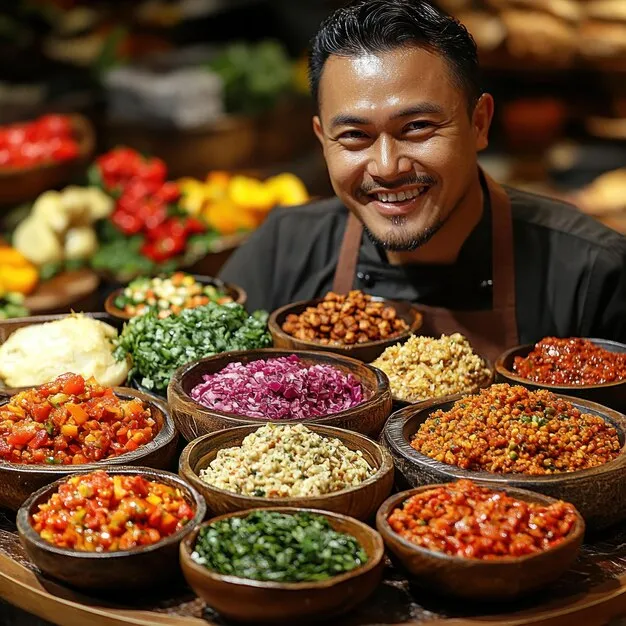
My Parents Fed Me Fear. I'm Cooking Something Different.
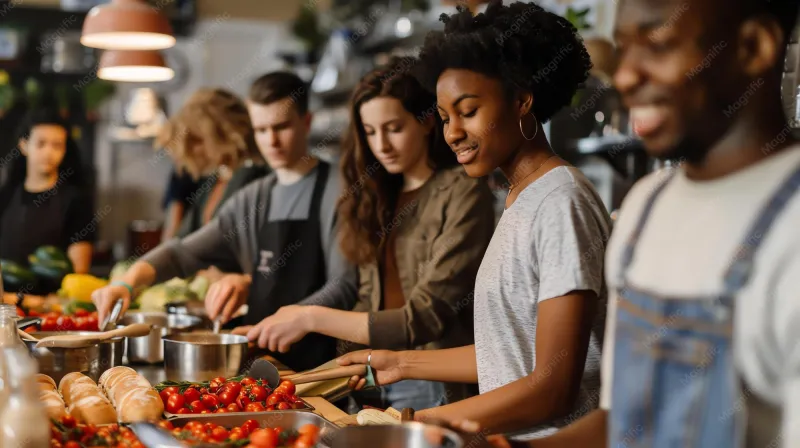
Photo: young adults cooking together in kitchen laughing, via img.freepik.com
Grow up in almost any American household and food comes with a side of something unspoken. Maybe it was a mother who talked about her own body like it was an ongoing problem to be solved. A father who grew up with not enough and now hoards, overstocks, eats past fullness out of an anxiety that never quite left him. A household where certain foods were "bad" and eating them came with a guilt hangover that lasted longer than the meal.
For many young Americans — particularly those in their late teens and twenties — the work of building a healthy relationship with food isn't just personal. It's archaeological. It requires digging through layers of inherited belief, unpacking what actually belongs to them and what was handed down without anyone ever asking if they wanted it.
This is the quiet rebellion happening at dinner tables across the country. And it's more intentional than any generation before it.
"I Didn't Know Food Could Just Be Food"
Jordan, 24, grew up in suburban Georgia in a household that orbited around her mother's perpetual diet. There was always a new plan on the refrigerator — low-fat, low-carb, points-based — and food was sorted, constantly and loudly, into categories of virtue and sin.
"Everything was either something you 'got to' eat or something you 'had to' avoid," Jordan says. "I internalized that so completely that by the time I was twelve, I was narrating my own eating in my head. Like a constant commentary. Should I really be having that? I already had bread today."
By college, Jordan was cycling through restriction and bingeing in a pattern she recognized, intellectually, as disordered — but couldn't seem to break. The shift came not from a therapist (though that helped too) but from TikTok, of all places. Specifically, from creators who talked openly about intuitive eating, about the research behind diet culture's psychological toll, and about the concept of food neutrality — the radical idea that a cookie is just a cookie.
"I genuinely had never heard anyone say food doesn't have moral value," she says. "It sounds so obvious. But I had to actually hear someone say it before I could start believing it."
Jordan now cooks for herself most nights — something her mother rarely did, relying instead on packaged diet foods and the occasional low-calorie frozen meal. The act of cooking, she says, is itself part of the healing. "When I make something from scratch, I'm not thinking about what it costs me. I'm thinking about what it gives me. That's completely new."
Scarcity Doesn't Disappear in One Generation
Not every food story is rooted in diet culture. For Marcus, 22, a first-generation college student from Chicago's South Side, the inherited pattern looked different — but felt just as heavy.
His grandparents had grown up poor. His parents had too, for stretches. The household relationship with food was shaped by genuine scarcity: you ate everything on your plate because waste was unthinkable, you ate past fullness because you weren't sure when enough would be available again, and you celebrated every good moment with the richest, most indulgent food you could afford because abundance, when it came, deserved to be honored loudly.
"I love my family's food. I love what it means culturally," Marcus is careful to say. "But I also had to separate the love for the food from the anxiety underneath it. They got tangled up together."
He started noticing the pattern in college when he realized he couldn't leave food on his plate without a specific, almost physical discomfort — even when he was genuinely full. He started reading about the psychology of scarcity mindsets and recognized his family in nearly every page.
"Understanding why helped more than anything. It wasn't about blaming anyone. It was about seeing the system clearly enough to decide which parts I wanted to carry forward."
Marcus still cooks the foods he grew up with — his grandmother's red beans and rice, his mother's smothered chicken. But he's learned to eat them differently. Slower. With attention. Without the low-grade panic underneath.
Building New Rituals
What's striking about the Gen Z approach to food healing is how intentional it is. Where previous generations might have swung from one extreme to another — abandoning family food entirely or doubling down on it uncritically — many young people today are doing something more nuanced: curating.
They're keeping what feels good and true. Releasing what doesn't. And, crucially, they're talking about it — with each other, online, in therapy, at their own dinner tables.
Anya, 26, grew up in a Russian-American household in Seattle where food was love, but also control. Meals were elaborate, non-negotiable, and refusing anything was taken as personal rejection. Fullness was irrelevant. Preference was irrelevant. You ate what was made, the amount that was given, and you were grateful.
"I spent years either eating everything put in front of me or avoiding food situations entirely," she says. "There was no middle ground. I didn't know how to want things for myself."
Now, Anya hosts a monthly dinner with friends that she calls, only half-jokingly, her "reclamation table." Everyone brings something. There are no rules about portions. Nobody comments on what anyone else is eating. It sounds almost aggressively simple — but for Anya, it represents something she never experienced growing up: a meal where everyone's hunger was treated as valid and individual.
"We're literally just having dinner," she laughs. "But we're also kind of healing something."
The Bigger Shift
What Jordan, Marcus, and Anya share isn't a specific diet or a set of food rules. It's a framework — one built on awareness, intention, and a willingness to examine what they inherited before deciding what to keep.
Psychologists who work with young adults note that this kind of conscious deconstruction is genuinely meaningful work. Eating patterns absorbed in childhood run deep, often operating below the level of conscious thought. Bringing them to the surface — naming them, questioning them — is the first step toward changing them.
But for this generation, it's also something more than self-help. It's cultural. The food conversations happening on social platforms, in friend groups, in therapy offices across the country are creating a shared language for something that used to be private and shameful.
The dinner table rebellion isn't loud. It doesn't come with manifestos. It looks like a 24-year-old making herself a meal without guilt-narrating every bite. It looks like a young man leaving food on his plate and sitting with the discomfort until it passes. It looks like a dinner party where the only rule is that everyone's welcome to want what they want.
One meal at a time, something is being rebuilt. And it's going to taste better than what came before.